The Modules
- Active Listening
- Agile 101
- The Agile Game
- Agile Requirements
- Backlog Grooming
- Business Case for Agile
- Coaching Questions
- Definition of Done
- Empirical Processes
- Estimation (Story Sizing)
- Experiencing Agility
- Multitasking
- Paper Prototyping
- Pair Programming TDD Demo
- Project Chartering
- Release Planning
- Retrospectives
- Scaling Scrum
- Self-Organization
- Sprint Termination
- Story Mapping
- SWOT Analysis
- Tapping Group Wisdom
- Theory of Constraints
- User Personas
- User Stories
- XP Technical Practices
- Our Teaching Style
- Certified ScrumMaster
- Certified Scrum Product Owner
- Agile Tools and Practices
- Test Driven Development in Java
- Test Driven Development in C#
- Advanced Scrum Master Skills
- Mastering Agile Requirements
- Agile Project Management
- Bootstrapping Your Scrum Team
- The Agile Product Manager’s Guide to the Galaxy
- Creating Agile Learning Games
- Custom Training, Coaching and Facilitation
- Brown Bag Sessions
- Training Modules
This module is included in the following workshops:
- Brown Bag Sessions
- Certified Scrum Product Owner
- Mastering Agile Requirements
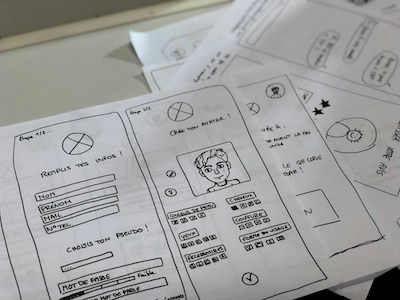
Paper Prototyping
Learn the very basics of a powerful way to design and evolve user interaction. Create and revise paper prototypes for a real system in this hands-on workshop module.
It is common to mock up a software product in HTML, PowerPoint, Adobe Fireworks or Photoshop, but consider an alternative to pixels: good old-fashioned paper. Paper prototyping removes all technological barriers and allows everyone into the design process. Not everyone who will have input during the design process knows HTML, and even if they do, they aren’t likely to jump in on the fly in the middle of a demo and redesign a page to show you exactly how they think the software should work.
But everyone who has graduated from kindergarten knows what to do with a stack of paper, pencils and a glue stick. By making your prototype accessible, disposable and non-precious, you encourage participation.
Carolyn Snyder, author of Paper Prototyping, lays out the benefits of the practice: