The Modules
- Active Listening
- Agile 101
- The Agile Game
- Agile Requirements
- Backlog Grooming
- Business Case for Agile
- Coaching Questions
- Definition of Done
- Empirical Processes
- Estimation (Story Sizing)
- Experiencing Agility
- Multi-Tasking
- Paper Prototyping
- Pair Programming TDD Demo
- Project Chartering
- Release Planning
- Retrospectives
- Scaling Scrum
- Self-Organization
- Sprint Termination
- Story Mapping
- SWOT Analysis
- Tapping Group Wisdom
- Theory of Constraints
- User Personas
- User Stories
- XP Technical Practices
- Our Teaching Style
- Certified ScrumMaster
- Certified Scrum Product Owner
- Mastering Agile Requirements
- Agile Project Management
- Bootstrapping Your Scrum Team
- The Agile Product Manager’s Guide to the Galaxy
- Creating Agile Learning Games
- Custom Training, Coaching and Facilitation
- Brown Bag Sessions
- Training Modules
This module is included in the following workshops:
- Agile Project Management
- Brown Bag Sessions
- Certified Scrum Product Owner
- Mastering Agile Requirements
Story Mapping
Many people are familiar with the “product backlog”, a prioritized list of user stories that is one of the artifacts of the Scrum framework. While the product backlog can be very useful for letting developers know what to work on next, its one-dimensional nature tends to limit the amount of information it radiates. In other words, the product backlog tells developers what to work on, but not necessarily why.
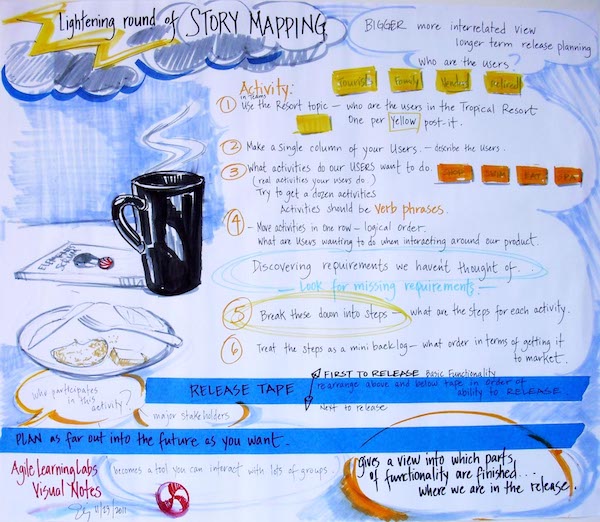
Story Mapping is a technique designed to help the Product Owner prioritize user stories into sensible releases that maximize value by placing emphasis on the users of the software and what they can accomplish when the software is released. It is a concept first put forward by Jeff Patton on his blog, Agile Product Design. Chris Sims wrote more about Story Mapping on InfoQ.
In this Story Mapping exercise, which makes an excellent in-house brown bag session for agile teams, participants will learn how to:
The result of the Story Mapping exercise is a two-dimensional representation of the users, their activities, and the user stories needed to implement the functionality they want, all in a big, visible “chart” that contains much more meaningful information than a simple backlog. The technique demonstrated is powerful, yet simple enough that participants in the exercise will be able to apply it immediately.