
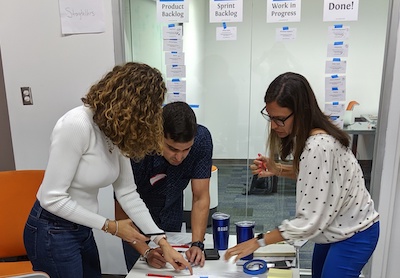
 The best way to understand scrum is to do it. You are about to become a member of an agile team. Over the course of three sprints, you’ll meet with your customer, gather requirements, make plans, build, and ship your product. The development environment includes: balloons, construction paper, playing cards and dice; no coding skills required. It’s a lot of fun to play, but the learning is quite serious. You will walk away with an understanding of scrum that goes beyond the theory, because you will have actually done it.
Abstract
This session immerses participants in a full project simulation, using scrum. They will develop a deep understanding of the concepts and practices of scrum, experientially. Scrum is a popular framework that supports teams in doing complex work. It came from software development and is now applied in a variety of domains including: biotech, marketing, and education.
During the simulation, participants will get opportunities to play all three scrum roles: product owner, scrum master, and team member. Over the course of three iterations, each team will:
- Meet with their customer to understand the customer’s needs
- Refine requirements and create work estimates for each customer request (user story)
- Plan a sprint
- Build product
- Receive feedback from the customer
- Inspect and adapt to improve their process, the product, and the team itself
The simulation requires no special skills, technical or otherwise. It does have just enough complexity that teams will encounter the same problems as they do in ‘real life.’ Using scrum over the course of three sprints, teams overcome those problems and ultimately deliver a satisfying product.
At the end, Chris Sims facilitates a debrief in which the participants identify the real-world issues they faced, how they overcame them, and how they can apply that learning back in their day-to-day environment. The simulation plays like a game, and leads to deep learning and lightbulb moments of insight.
ScrumSim is based on the XP Game, an open-source learning tool by Vera Peeters and Pascal Van Cauwenberghe.